Babson College Says Generative AI Is Changing the Game for Founders. Here's What That Means for You.
Babson College Says Generative AI Is Changing the Game for Founders. Here's What That Means for You.
Not Having a Technical Background Used to Mean You Had to Hire Around It
That is not true anymore, and the research backing that claim comes from a source you cannot dismiss as hype.
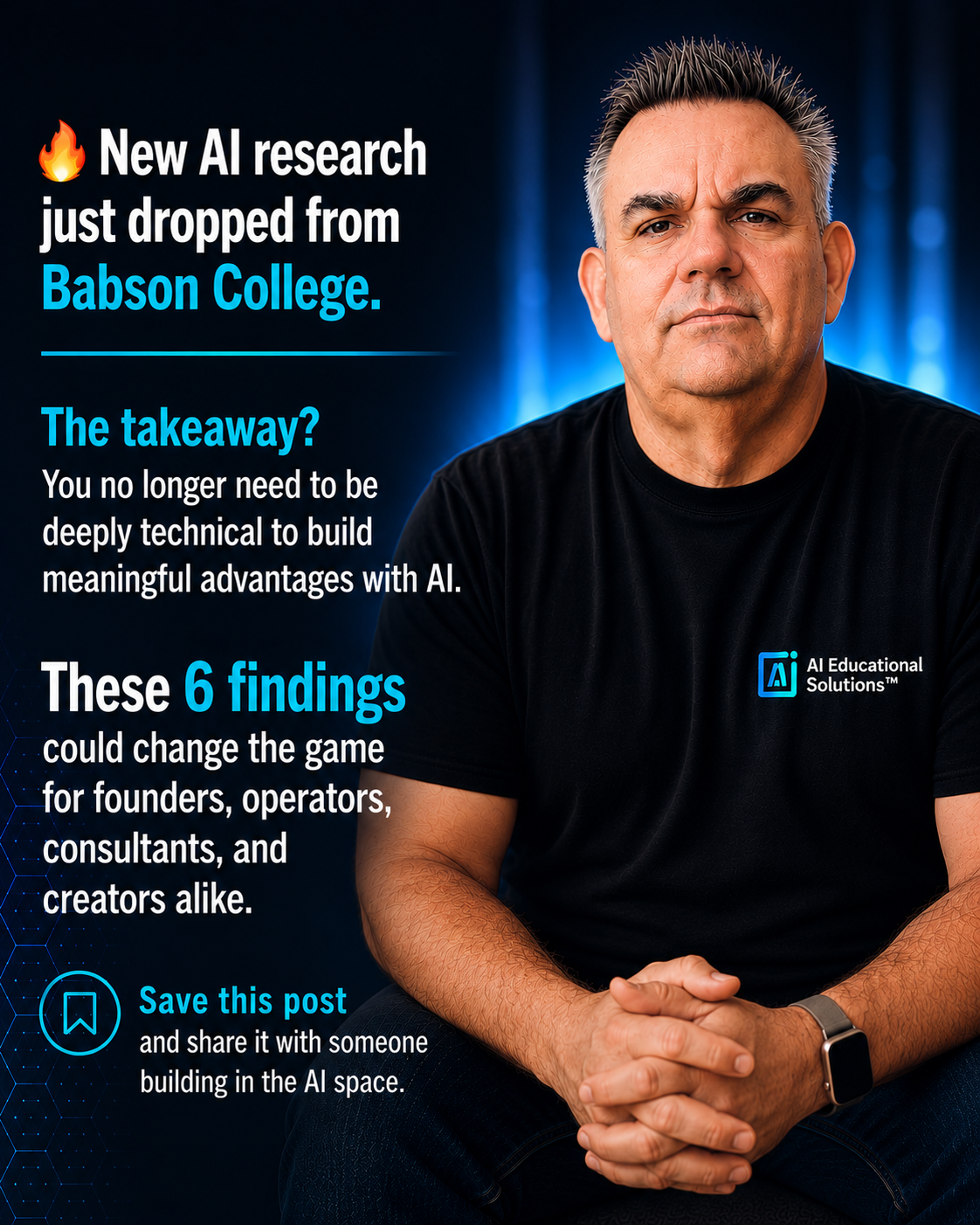
Babson College, consistently ranked the top entrepreneurship school in the country, just published findings on what generative artificial intelligence (AI) actually means for founders. Their conclusion is direct. Non-engineers can now innovate in new ways, including producing code and accelerating the content and knowledge work that used to require specialized hires.
This is not a story about minor efficiency gains. It is a story about a structural shift in what a non-technical founder can build, on their own, without a technical team underneath them. If you have been waiting to start something because you cannot code, you have been working around the wrong constraint.
Image created in ChatGPT
The Code Barrier Is Not What It Was
Babson's research specifically names code production as one of the new capabilities generative AI puts in the hands of non-engineers. You do not need to learn to write code. You need to learn to describe what you want with enough precision that AI can produce it.
Those are two different skills, and the second one plays to how entrepreneurs already think. If you can describe a feature to a developer clearly enough that they build the right thing, you can describe it to AI. The first version will not be perfect. It will be real, fast, and yours to refine.
Content and Knowledge Work Now Have a Co-Creator
Babson highlights AI's ability to directly transform knowledge and content management. For a non-technical founder, here is what that looks like in practice.
Every document, proposal, standard operating procedure (SOP), onboarding guide, and content piece that used to require a team or a budget can now be produced by one person with a clear prompt and a review pass. The gain is not just speed, although speed is real. The gain is consistency. When you can produce the same quality output at ten o'clock on a Sunday night that you used to need two weeks and a full team to produce, your business stops depending on your best day.
You Can Test Whether Your Offer Is Worth Building Before You Build It
Babson points directly to AI's ability to provide instant feedback on the viability of ideas. For entrepreneurs, that collapses the gap between idea and validated assumption.
You no longer have to build the thing to find out whether it's worth building. A well-constructed prompt can pressure-test your offer from the buyer's perspective, surface objections you have not considered, and show you where the positioning breaks down. That used to require a market research budget, a focus group, or a slow and expensive launch just to learn what was wrong with it.
The founders who build this step into their pre-launch process will waste fewer resources on offers that never had a chance.
The Real Advantage Is Iteration Speed, Not Tool Access
Here is the part that matters most, and it is easy to miss. Every non-technical entrepreneur reading this has access to the same AI tools you do. The tools themselves are not the advantage.
What Babson frames as a structural shift is really an acceleration of how founders test and iterate. The founder who runs ten versions of an offer, a pitch, or a positioning statement while everyone else runs two does not win because they have better software. They win because they made more decisions, with better feedback, in less time. That is a behavioral advantage. It was always available. AI just dropped the cost of one iteration loop close to zero.
Documentation Is Now a Solo Founder Superpower
Most small businesses run on tribal knowledge. The process lives in the founder's head. Every new hire starts at zero. Every handoff is a rebuild from scratch.
Babson's findings on AI transforming knowledge and content management apply directly here. A solo founder with a well-configured AI system can now produce the SOPs, onboarding documents, and process guides that previously required an operations hire. The founders who build those systems in year one will be able to hand off work, bring on a team, and scale without reconstructing everything later. This is one of the most underused applications of AI for small business owners. It compounds quietly, until the day it saves you.
The New Technical Skill Is Clarity, Not Code
You have probably spent time this year testing AI tools and wondering why some outputs feel usable right away while others need a full rewrite before they look anything like you.
Babson's research points toward the answer without stating it directly. AI amplifies the quality of your thinking, not the size of your tool stack. A vague instruction produces a vague output. A precise, context-rich, audience-aware instruction produces something you can actually use. The non-technical founders pulling ahead with AI are not the ones with the most tools. They are the ones with the clearest thinking about what they want, who they serve, and what good looks like.
That is an entrepreneurial skill. If you have built anything real, you already have the foundation for it.
You are not behind. You are probably closer than you think.
If you want help figuring out where to start, that conversation is open whenever you are ready.

Michael Carmine
Founder & CEO | AIEducationalSolutions.org