What Happens to My Business If the AI Tool I Rely On Changes Its Plan?
Most small businesses cannot name the AI workflow that would stop first, and one afternoon of planning closes that gap.
By Michael Carmine | Founder and CEO, AI Educational Solutions (AIES), LLC
Only 6 percent of senior executives surveyed by Zapier said they could stop using their main Artificial Intelligence (AI) vendor without any interruption. Those organizations have procurement teams and legal reviews. If they cannot walk away cleanly, a business with five to 15 employees and a shared login probably cannot either.
Not because owners are careless. Because AI arrived one small task at a time, and nobody wrote down which tasks became load-bearing.
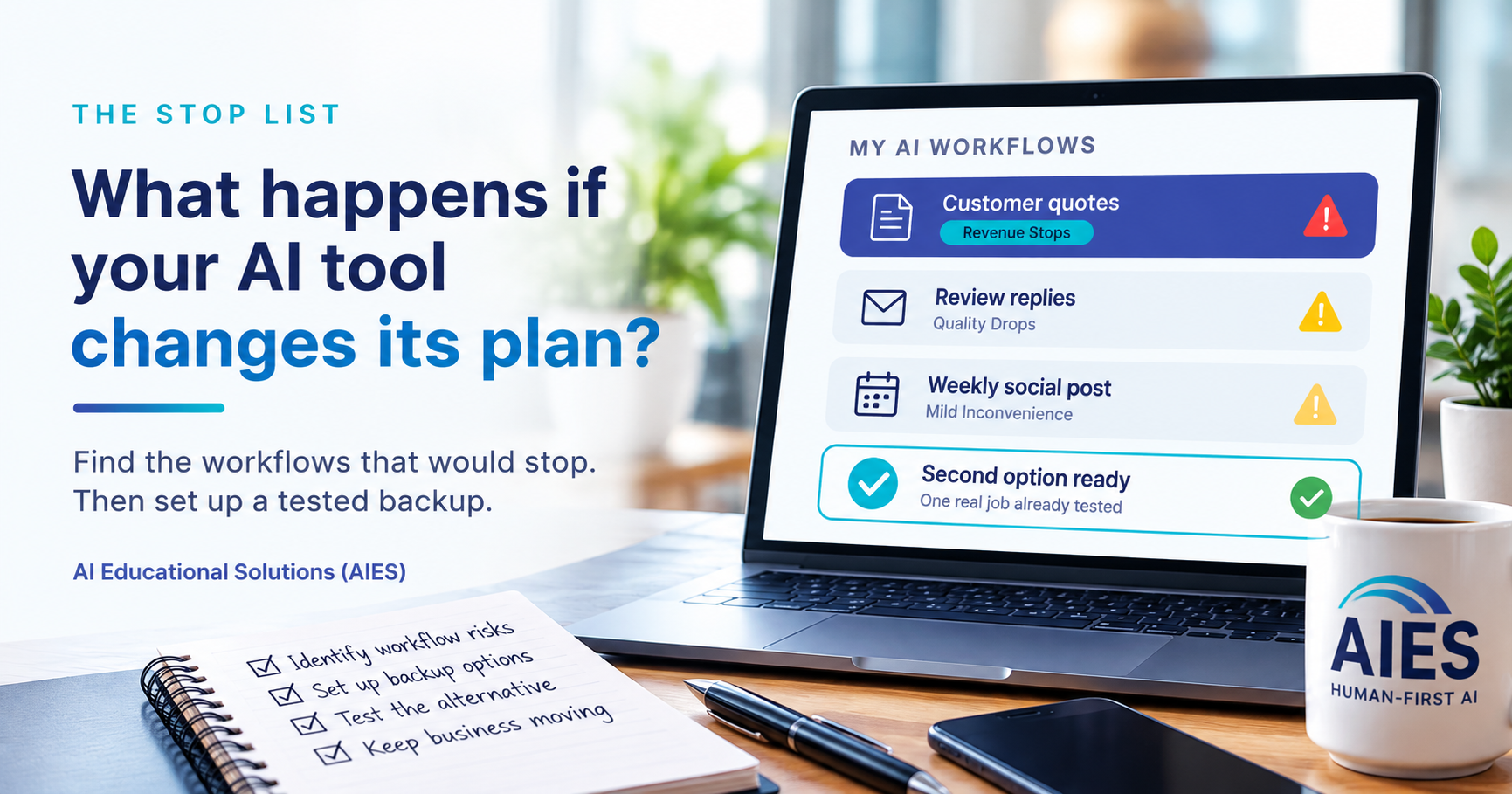
Here is the direct answer to the headline. If your AI provider changes its plan, pricing, or usage limits, the workflows tied to that plan will slow down or stop until you adjust. You protect your business by knowing which workflows would hurt, and by having a second provider already set up and tested for the one or two that matter most. "Tested" means your instructions are loaded and one real job has run from start to finish. A bookmarked comparison article does not count.
What happens when your AI tool changes its pricing, features, or usage limits? Identify critical business workflows and test a backup solution before disruptions affect your operations. | AI Educational Solutions (AIES)
Key Takeaways
• The likely risk is not a provider disappearing. It is a plan, tier, or limit changing under a workflow you depend on.
• Anthropic's published policy commits to at least 60 days' notice before retiring a public model. Pricing and plan changes may move faster.
• In the Zapier survey, 89 percent of executives believed they could switch vendors within four weeks, yet 58 percent of those who tried said it failed or took much more effort than expected.
• You need a tested backup for the two or three workflows you cannot afford to lose, not a second subscription for everything.
The Problem: Nobody Wrote Down What Became Load-Bearing
Ask yourself one question. If your main AI tool tightened its usage limits next month, which of your tasks would stop running? Not which ones would irritate you. Which ones would actually stop.
Most owners cannot answer. AI worked its way into your business one small favor at a time, until a subscription that began as an experiment became something your week depends on. Anything that bears weight and has no documentation is fragile. That is true of a wall, and it is true of a workflow.
Consider an illustrative example, not a client. A home service company uses AI to turn technician notes into customer quotes, and also to draft review replies and a weekly social post. If the quote tool stops on a Monday, jobs wait and revenue slows. If the social post tool stops, nobody notices until Friday.
Switching is not painless, and you should not pretend it is. Your prompts were written around how one model responds, and your staff know one screen layout. That difficulty is the reason to prepare early, so a change in plan costs you an afternoon instead of a customer.
The Evidence: Why the Ground Is Still Moving
One. The provider is not the weak point. Reporting on Anthropic's filing put 2025 revenue near $4.6 billion, roughly twelve times the prior year, with two straight quarters of adjusted operating profit. The same reporting lists $7.33 billion in compute and infrastructure spending, about triple the year before, plus $518 billion in future commitments. When costs grow that fast, plan structures get revisited. That is arithmetic, not malice.
Two. The notice period is published, and it is short. Anthropic's documentation commits to at least 60 days notice before retiring a public model. Two 2026 retirements each came about two months after the announcement. Pricing and plan changes are a separate matter and tend to move faster, so read each provider's own policy.
Three. Feeling ready and being ready are not the same. In the Zapier survey, 89 percent of executives believed they could move to a new vendor within four weeks. About two-thirds had actually tried, and 58 percent of those said it failed or took much more effort than expected. If you remember one statistic from this article, make it that one.
The Solution: The Stop List and the Second Option
I teach Human-First AI, which means people stay accountable for the work AI helps produce. That includes deciding what happens when a tool changes. Three habits make that decision easy.
Part one: the Dependency Map. List every workflow where AI does real work with a deadline attached. Most small businesses end up with four to 12. Rate each by how badly a Monday morning outage would hurt, using three labels only: Must Run, Can Slow, or Can Wait. Most land in Can Wait. You are looking for the one or two that do not.
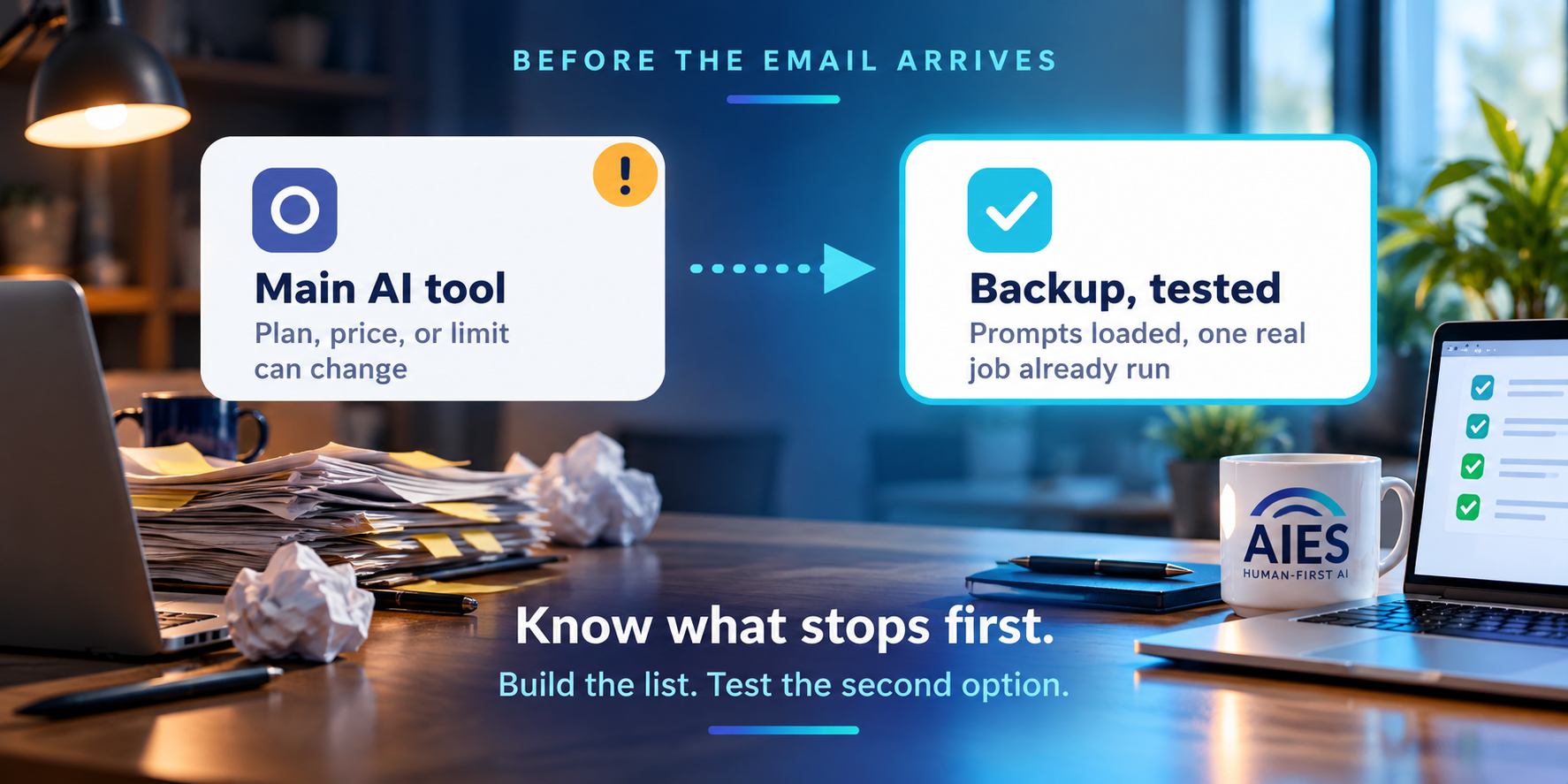
Part two: the Standby Tool. For each Must Run item, and only those, build a working alternate path on a different provider. Working means you ran a real job through it from start to finish and saved the result. A favorite you read about is not a fallback. Run the test while the stakes are zero, because your prompt will need rewording and the formatting will shift. Learning that on a slow afternoon costs a little time. Learning it mid-outage can cost you an account.
Part three: the AI Playbook. For each Must Run task, write a one-page entry: what the task is for, what goes in, your instructions to the AI, one example result you would be proud to send, and the person who reviews it before it goes out. That last line is the Human-First part. Keep the pages in a folder you control so a new tool, or a new hire, can pick up the job.
Do This in One Afternoon
List your AI workflows on paper. Give it 20 minutes, with no software open.
Rate each one. Use Must Run, Can Slow, or Can Wait. Expect one or two in Must Run.
Write a playbook page for each Must Run task. Plan on about 20 minutes per page.
Set up a second provider and run one real deliverable through it. Save the result beside the original so you can compare quality.
Set a quarterly reminder. Spend 15 minutes checking provider announcements and rerunning one job on your backup.
Don't wait for an unexpected AI pricing or policy change to disrupt your business. Prepare a second AI tool, load your essential prompts, and test a real task so your business can keep moving. | AI Educational Solutions (AIES)
A Prompt to Start Your Audit
AI can draft the first pass of your audit. You still make the final call on the ratings, because you know which jobs carry revenue. Paste this into the tool you already use:
Act as an operations consultant who works with non-technical small business owners. I will list the AI tools I pay for and the tasks I use them for. Rate each task as Revenue Stops, Quality Drops, or Mild Inconvenience if the tool changed its pricing, plan, or limits tomorrow. For each Revenue Stops task, recommend a backup provider to set up and tell me which files I should store outside the vendor's platform. Ask me any questions you need before you answer.
Frequently Asked Questions
How much warning do AI providers give before retiring a model or changing a plan?
It depends on the provider and the change. Anthropic's published policy commits to at least 60 days before retiring a public model, and its history shows about two months in practice. Pricing and plan changes are separate and may move faster, so read each provider's own policy page instead of assuming.
Is a second paid AI subscription worth it?
Usually not. Many providers offer a free tier that can hold your prompts and run one real test job. Pay for a second plan only when a single workflow would stop revenue and you cannot tolerate even one day of reduced output. For most owners, a tested free account is enough.
Can I reuse my prompts as they are on a different AI tool?
Partly. Structure, context, and instructions usually transfer well. Tone, formatting, and length often need adjusting, and tricks built for one model may not carry over at all. Plan on 15 to 30 minutes of tuning for each important prompt, which is exactly why you do it before you need it.
Are the big AI companies at risk of going under?
Not according to the reporting cited here, which describes fast revenue growth and two quarters of adjusted operating profit for Anthropic. The instability is in pricing, tiers, and limits across the industry. Your risk is a plan changing under your workflow, not a provider vanishing. Verify the figures against original coverage.
The Close
Here is what I want you to hear. No provider will ask your opinion before changing its tiers, limits, or packaging. Your part is deciding whether the change lands as a minor update or a crisis, and that depends on what you prepared ahead of time.
Only 6 percent of executives could walk away from their main AI vendor without interruption. You do not need to be in that 6 percent for every task. You need to be there for the two or three that pay your bills.
A tool you have mapped is an inconvenience when it changes; a tool you have not is a crisis.
If you want a second set of eyes on your Dependency Map, bring it to a free 20-minute call and we will work out which workflows need a standby tool: Book Your Free 20-Minute Call.
Sources:
•Figures originally attributed in that article to: a Zapier and Centiment executive survey (January 30 to February 6, 2026); CNBC, TechCrunch, and Fortune coverage of Anthropic's IPO filing (September 28 and 29, 2026); and Anthropic's model deprecation documentation. Original links were not provided in the source article.
Michael Carmine, Ed.D., MBA, is the Founder and Chief Executive Officer of AI Educational Solutions (AIES), a boutique AI consulting and training firm based in Chapin, South Carolina, serving small and medium businesses across the Midlands and nationally. He holds a doctorate in Curriculum and Instruction with a specialty in Instructional Design and Technology, and has trained more than 1,150 professionals across the United States, South Korea, and Qatar. Most AI consultants come from technology. Michael comes from education, and that difference shapes every tool he builds.
Meet Michael, Founder & CEO of AI Educational Solutions, LLC
Passionate About Making AI Simple and Useful
Michael started AI Educational Solutions, LLC after noticing a major gap: many small businesses and educators were investing in AI training that was too technical, too generic, or failed to deliver real-world results. He believes organizations should never waste time, money, or momentum on solutions that look impressive in theory but fail in practice. When companies invest in AI, they should walk away with operational clarity, improved efficiency, and a competitive advantage. That standard is non-negotiable.
AI Educational Solutions helps by assessing your needs, suggesting the right tools, and providing hands-on training so you leave feeling confident in using AI effectively.