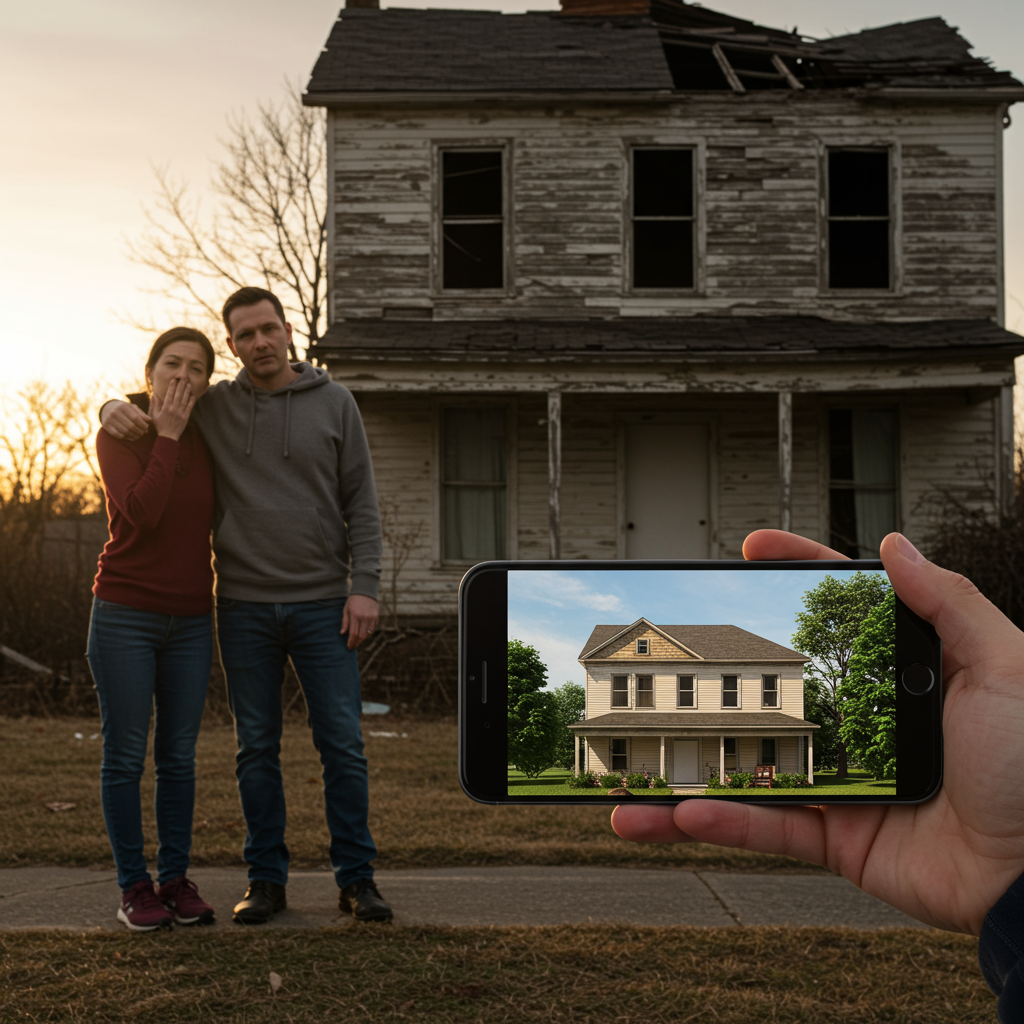
Real Estate Housefishing! What is it?
Is It Real or Is It AI? The New California Law Changing Real Estate Photos
We’ve all seen them: the property listings with grass that’s suspiciously green, rooms filled with perfect (yet generic) furniture, and somehow, all the nearby power lines have just vanished. For years, "virtual staging" and digital enhancements have been common practice in real estate marketing.
But in California, the era of the mystery edit is officially over.
As of January 1, 2026, a new consumer protection law, Assembly Bill 723 (AB 723), took effect. Signed by Governor Newsom, this law mandates honesty in real estate marketing, drawing a clear line between polished editing and misleading manipulation.
Whether you are a homebuyer who feels like they’ve been "catfished" by a property listing or a real estate agent trying to navigate the new rules, AB 723 is a major shift. Here’s what you need to know about California's new disclosure law.
Image created with AI☝️
See an actual video of Housefishing.
The core objective of AB 723 is transparency. The law doesn’t ban the use of digitally altered or AI-enhanced images; instead, it enforces a "right to know" for potential buyers.
If any agent, broker, or marketer uses a "digitally altered image" in a property listing, they are now required to do two things:
Disclose the Alteration: A "reasonably conspicuous" statement must be included on or right next to the image. Expect to see labels like "Digitally Altered" or "Virtually Staged" as standard practice.
Provide the "Before" Shot: This is the game-changer.
On any website the agent or broker controls, the original, unaltered photo must be included in the photo carousel.
For other advertising, like social media or print flyers, they must provide a clear way to see the original, such as a direct link, URL, or QR code.
Where the Line is Drawn: "Virtual Staging" vs. "Basic Editing"
The law makes a specific distinction between major digital renovations and standard photo enhancements. As a general rule, if the edit fundamentally changes what the property is, it requires disclosure.
What Now Requires Disclosure:
If the edit creates a scenario that does not exist in reality, you must disclose it. This includes:
Virtual Staging: Digitally adding (or removing) furniture.
Structural Changes: Removing walls, changing flooring type, or altering the roofline.
Major Landscaping: Digitally adding green grass, installing a pool, or planting mature trees where none exist.
Removing "Eyesores": Digitally erasing power lines, utility poles, neighboring houses, or nearby construction.
What Does NOT Require Disclosure:
Routine, professional photography edits that enhance quality without misleading the eye are still permitted without specific labeling. This includes:
Adjusting brightness, contrast, or color balance.
Cropping or sharpening the image.
Correcting camera distortion (making straight lines appear straight).
Why the Change? The Impact on Everyone
AB 723 is designed to create a fairer and more honest marketplace. Here is how it affects the key players in the real estate transaction:
🏡 For Homebuyers
This is a huge win for consumer protection. The goal is to eliminate the "bait-and-switch" frustration where a property looks pristine and move-in ready online, but is in disrepair when you arrive for a showing. Buyers can now make more informed decisions about which homes are worth their time.
🤝 For Real Estate Agents and Brokers
This is a major change in workflow. MLS (Multiple Listing Service) platforms across California have already updated their rules to align with AB 723. For every "virtually staged" or altered photo an agent uploads, they are now also required to upload the "before" shot.
The stakes for non-compliance are high. Because this is now part of the California Business and Professions Code, willful violations are considered a crime and could lead to professional discipline from the Department of Real Estate (DRE).
A New Era of Honesty
The use of AI and high-end editing in marketing will continue to grow. California is simply ensuring that as the technology evolves, the rules of fair play do too.
For decades, the standard has been Caveat Emptor "Buyer Beware." With AB 723, California is taking a step closer to "Agent Disclose."
Michael Carmine
Founder & CEO | AIEducationalSolutions.org