Is Google Charging You for Calls You Never Answered?
By Michael Carmine | Founder, AI Educational Solutions (AIES), LLC
It is 2:14 on a Tuesday afternoon in July. Your best technician is on his back under a condenser, your office manager is on the other line with a warranty claim, and your phone lights up with a number you do not recognize. It rings six times. It goes to voicemail. The caller hangs up before the beep and dials the next company on the list.
That call has always cost you a job. Under Google's own rules for Local Services Ads, it can also cost you money.
The short answer: Yes, in some cases. Google's help pages say a call you miss during your business hours is a charged lead if the caller stays on the line for more than 20 seconds, and a call that reaches voicemail or a greeting is treated the same way. Google also says it filters spam and credits poor leads over 30 days. If you run Local Services Ads (LSA), audit your missed calls this week, fix the free causes first, and decide whether an answering tool is worth adding.
Key Takeaways
Google's help pages say a missed call during business hours is a charged lead if the caller stays on the line more than 20 seconds, and voicemail counts.
Google is also moving LSA campaigns into Google Ads as Performance Max campaigns with pay-per-lead goals, starting with some home service advertisers in 2026.
Published estimates of how many calls home service companies miss vary widely, so measure your own number instead of trusting a headline.
Most missed calls have free fixes: call forwarding rules, a staffed lunch hour, and a faster callback habit.
AI answering tools are optional, carry disclosure rules you must check, and should never handle an emergency alone.
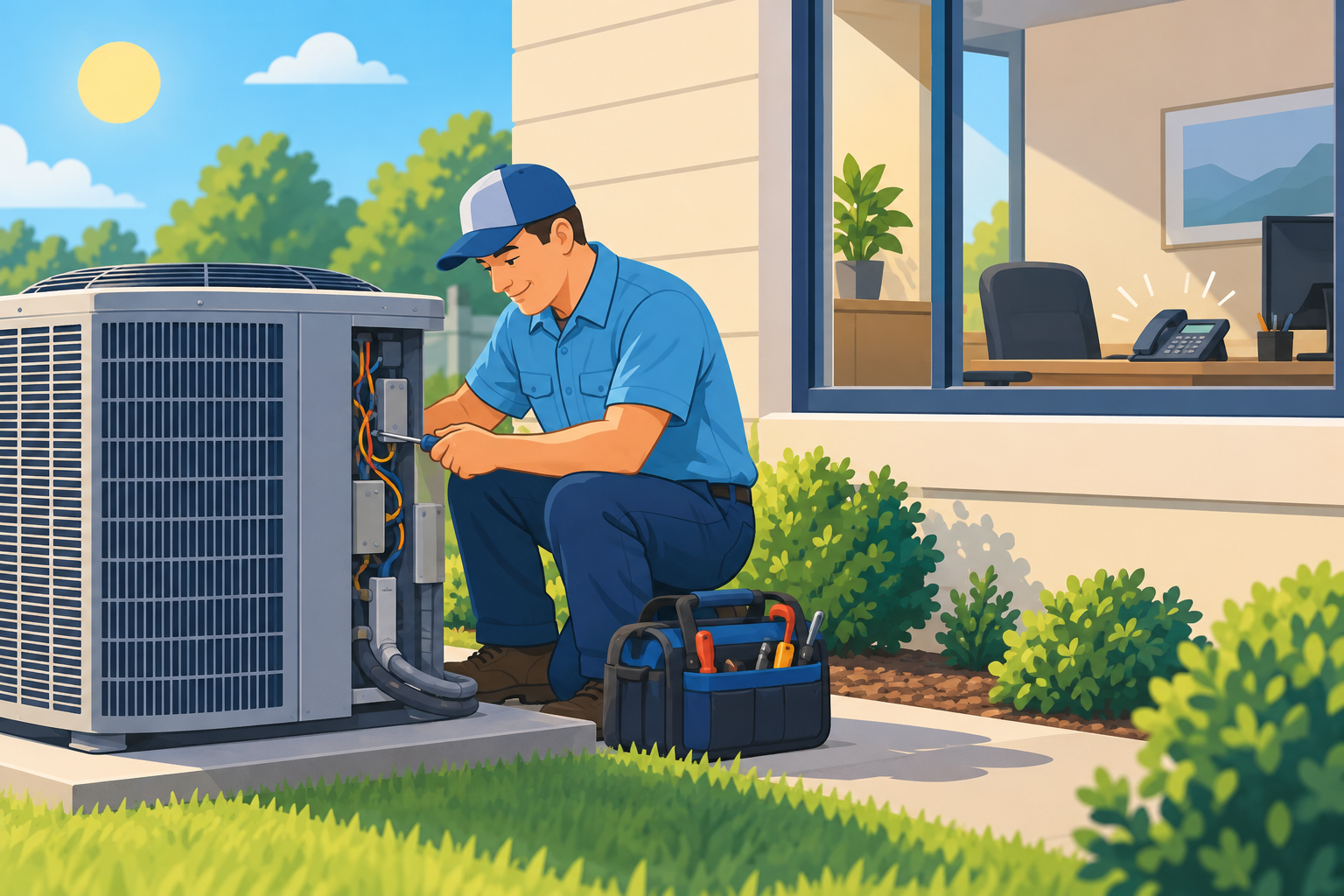
When HVAC technicians are busy serving customers, incoming calls can go unanswered and potential business opportunities may be missed.
What Google's own help pages say
Local Services Ads are the Google listings that sit above the regular search results. Instead of paying per click, you pay per lead. Google's How leads work page spells out what counts as a lead for a phone call.
Here is what it says, in plain terms:
Answered calls. If you answer, or call the customer back and speak with them, the call is judged on the conversation, not the ring time.
Missed calls. If you miss a call during your business hours and the caller stays on the line for more than 20 seconds, it can be charged.
Voicemail and greetings. A call that reaches voicemail or an automated greeting during business hours is charged if the caller stays on more than 20 seconds, whether or not they leave a message.
Phone menus. If your greeting asks callers to press a key, the 20 seconds start at the first key press. A caller who hangs up without pressing a key is not charged.
Business hours. Missed calls are charged only during the business hours set in your Google Business Profile.
Repeat callers. The same number or email is not charged again within 15 days of contact.
Spam and poor leads. Google says its systems filter spam and duplicates, and it reviews leads over 30 days and applies a credit to your account balance when a lead is invalid. You can also flag a poor lead through the feedback survey on the Leads page. The help page describes no formal dispute process.
A word on timing. PPC Land reported on October 6, 2026, that Google bills missed LSA calls over 20 seconds, and described the rule as new from October 1. Google's help page carries no date, so the October 1 start is unconfirmed. What is confirmed is that the rule is written down today, and that Google's page addresses voicemail handling, which PPC Land had described as unclear.
There is a second change to watch. Google's help page on the transition says LSA campaigns are moving into Google Ads as Performance Max campaigns with pay-per-lead goals. Select U.S. home service advertisers, including plumbing, HVAC, electrical, and roofing, began moving in August 2026, with broader groups later in 2026. The account administrator gets an email 14 days before the move. Manual bidding such as a maximum cost per lead is no longer supported, and historical performance reports do not carry over, so save yours first.
This story also has a vendor attached. The PPC Land piece is about Invoca, a call analytics company that packages AI agents that answer calls. That does not make the reporting wrong. It does mean you should ask of every number in this space: who sells the fix?
Before investing in an AI answering service, track your incoming calls to understand how many are answered, missed, or sent to voicemail.
The problem is bigger than the bill
Let me be direct about what this change does and does not do. It adds a possible cost to a problem you already had. The problem itself is the missed call.
Home service work runs on the phone. A homeowner whose air conditioner quit does not browse. They call, and if nobody answers, they call the next name. The customer you lost never shows up in a report. You see an empty slot on the schedule and blame the season.
Now add Google's billing rule. A missed call that runs past 20 seconds during business hours, including one that reaches your voicemail or greeting, can become a charge on your account. You may pay for a lead you did not get to work. You can lose the job and pay for the privilege.
So the real question is not "Should I buy AI?" It is "Where are my calls going right now, and what does each one cost me?"
The statistics disagree, and you should know why
If you search for how many calls home service businesses miss, you will find numbers that do not agree. A Stealth Agents research page from September 2026 collects several published figures, and they range from low to very high percentages. The spread comes from how each source defines a "missed" call.
Some count only calls that rang through to voicemail. Some count calls that went unanswered on the first try, even if the shop called back within minutes. Some count every inbound call, including vendors and wrong numbers. Some come from companies that sell answering services, which gives them a reason to favor the bigger number.
I am not telling you the statistics are wrong. I am telling you that no national figure describes your shop. Your number could be low or high, and your own phone records can tell you in an afternoon.
This is why the first step in this post is a count, not a purchase.
Step one: run a seven-day missed-call audit
You need three things: your phone system's call log, a spreadsheet, and about forty-five minutes.
Export seven days of inbound calls. Most business phone systems and mobile carriers let you download a log. If you run LSA, also open your LSA dashboard and export the lead list for the same dates.
Mark each call as answered, missed, or voicemail. Add a column for the time of day.
Mark which missed calls were called back, and how long it took. If you cannot tell, that is the finding.
Add up the pattern. Look for clusters. Lunch hour, the first thirty minutes of the morning, and the end of the day are common.
Match the LSA leads against the log. If Google shows a billed lead and your log shows no answered call, you have found the exact leak this new rule is built to bill.
Write down three numbers: how many calls came in, how many nobody answered, and how many of those got a callback inside fifteen minutes. That last number is the one that tells you whether you have a phone problem or a follow-up problem.
Step two: fix the free causes first
Before any software, look at the fixes that cost nothing.
Forward calls in a chain. Set the main line to ring the office, then the owner, then a second technician, in that order. Many phone plans include this.
Cover the lunch hour. If calls cluster at noon, stagger lunch so one person always has a phone.
Shorten the greeting. If a caller hears fifteen seconds of options before reaching a person, the 20-second mark is already behind them.
Send a text back. A missed-call text such as "Sorry we missed you. What is the address and what is going on?" gets a reply from many callers who would otherwise move on.
Set a callback rule. Any missed call gets a callback inside fifteen minutes during business hours. Write the rule on the whiteboard.
Dispute questionable leads. Check each lead's Charge Status on the Leads page and use the feedback survey on poor leads. Google says it credits invalid leads after a 30-day review, but its help page describes no formal dispute process. Also confirm your business hours in your Google Business Profile, since missed calls outside them are not charged.
Step three: decide whether an AI answering tool belongs in your shop
Some owners will look at the audit, see a real number, and want help covering the calls that no schedule change can fix. An AI voice agent is one option. It is not the only one. A human answering service and a part-time dispatcher are others.
If you consider an AI agent, here is the honest picture.
What it can do well. A voice agent can pick up inbound calls at 2:14 in the afternoon, collect a name, address, and the problem, and put it in your inbox. ServiceTitan's overview of AI virtual agents in HVAC, published in March 2026, describes this kind of intake and scheduling use, and it comes from a vendor, so weigh it as such.
What it should not do alone. Anything involving a gas smell, no heat in winter for a household with a baby, or a flooding basement needs a person. Build a rule so that emergency language sends the call straight to a human.
What the law may require. Rules about disclosing that a caller is talking to an AI are changing. A JustCall guide updated October 15, 2026 summarizes the landscape, and it is a vendor article, not legal advice. The safe habit is to say it in the first sentence: "You have reached Smith Heating and Air. I am an automated assistant, and I will get your details to our team." Ask your attorney before you launch, because the rules differ by state and by use.
Where it is lowest risk. Inbound calls are the safest place to start. Outbound calls and anything that sounds like sales bring a different set of rules. Keep the first use simple.
And be careful with the pitch. A tool that answers every call can also answer calls you would rather not pay for. Ask any vendor how the tool handles spam, how it logs calls for LSA disputes, and what it costs per month at your call volume.
What this means for your next seven days
Here is a plan you can run without buying anything.
Today: Export your call log and LSA leads for the past seven days.
Tomorrow: Count answered, missed, and called back inside fifteen minutes.
This week: Apply two free fixes from step two.
Next week: Rerun the count. If the number moved, you have your answer. If it did not, you have a reason to look at coverage options.
At AI Educational Solutions (AIES), we start with the same question in the free AIES Readiness Check: where does AI help your shop, and where does it add risk? Sometimes the honest answer is a rule on a whiteboard.
Frequently Asked Questions
Does Google really charge for calls I did not answer?
Yes, in some cases. Google's help page says a call you miss during business hours is a charged lead if the caller stays on the line more than 20 seconds, and voicemail counts. Google filters spam and credits invalid leads after 30 days. Check your own account for current terms.
How do I find out how many calls I miss?
Export seven days of inbound calls from your phone system and your LSA dashboard. Mark each call as answered, missed, or voicemail, then note which got a callback and how fast. Your own count beats any national statistic, because definitions of a missed call differ across studies.
Do I need an AI receptionist to fix this?
No. Many missed calls come from lunch hours, long greetings, and no callback habit, and all of those have free fixes. An AI answering tool is one option after you know your number. A human service or a part-time dispatcher is another.
Do I have to tell callers they are talking to an AI?
Disclosure rules for AI voice agents are changing, and they vary by state and use. The safest habit is to say it in the first sentence of the call. Because this is a legal question, confirm your obligations with an attorney before launching.
What should an AI answering tool never handle alone?
Emergencies. A gas smell, a flooding basement, or no heat for a vulnerable household should route straight to a human. Write that rule into any tool you use, and test it by calling it yourself with emergency phrases.
One last thing
The 20-second rule is written down. The missed call is older. The owners who come out ahead will be the ones who measured it first.
If you want a second set of eyes on your call log, book a free 20-minute call with us or take the Readiness Check. Bring your numbers. We will tell you plainly whether you need a tool or a whiteboard rule.
Michael Carmine, Ed.D., MBA, is the Founder and Chief Executive Officer of AI Educational Solutions (AIES), a boutique AI consulting and training firm based in Chapin, South Carolina, serving small and medium businesses across the Midlands and nationally. He holds a doctorate in Curriculum and Instruction with a specialty in Instructional Design and Technology, and has trained more than 1,150 professionals across the United States, South Korea, and Qatar. Most AI consultants come from technology. Michael comes from education, and that difference shapes every tool he builds.
Meet Michael, Founder & CEO of AI Educational Solutions, LLC
Passionate About Making AI Simple and Useful
Michael started AI Educational Solutions, LLC after noticing a major gap: many small businesses and educators were investing in AI training that was too technical, too generic, or failed to deliver real-world results. He believes organizations should never waste time, money, or momentum on solutions that look impressive in theory but fail in practice. When companies invest in AI, they should walk away with operational clarity, improved efficiency, and a competitive advantage. That standard is non-negotiable.
AI Educational Solutions helps by assessing your needs, suggesting the right tools, and providing hands-on training so you leave feeling confident in using AI effectively.