What Is Meta Muse and Should Your Small Business Pay Attention?
On September 8, 2026, Meta launched something that deserves more than a headline. Most AI news disappears in 48 hours. This one will still matter in 12 months.
Meta (formerly Facebook, Inc.) introduced Muse, a personal artificial intelligence (AI) agent that does not just answer questions. It takes action. It books appointments, sends emails, fills out forms, negotiates bills, and works through multi-step goals on your behalf, all inside a dedicated secure computer it runs on in the cloud.
That is a meaningfully different category from the AI tools most small business owners are using today.
This post explains what Muse actually is, what credible sources are saying about it, where the legitimate concerns live, and what a realistic first step looks like for a Small and Medium-Sized Business (SMB) owner who wants to stay informed without getting burned.
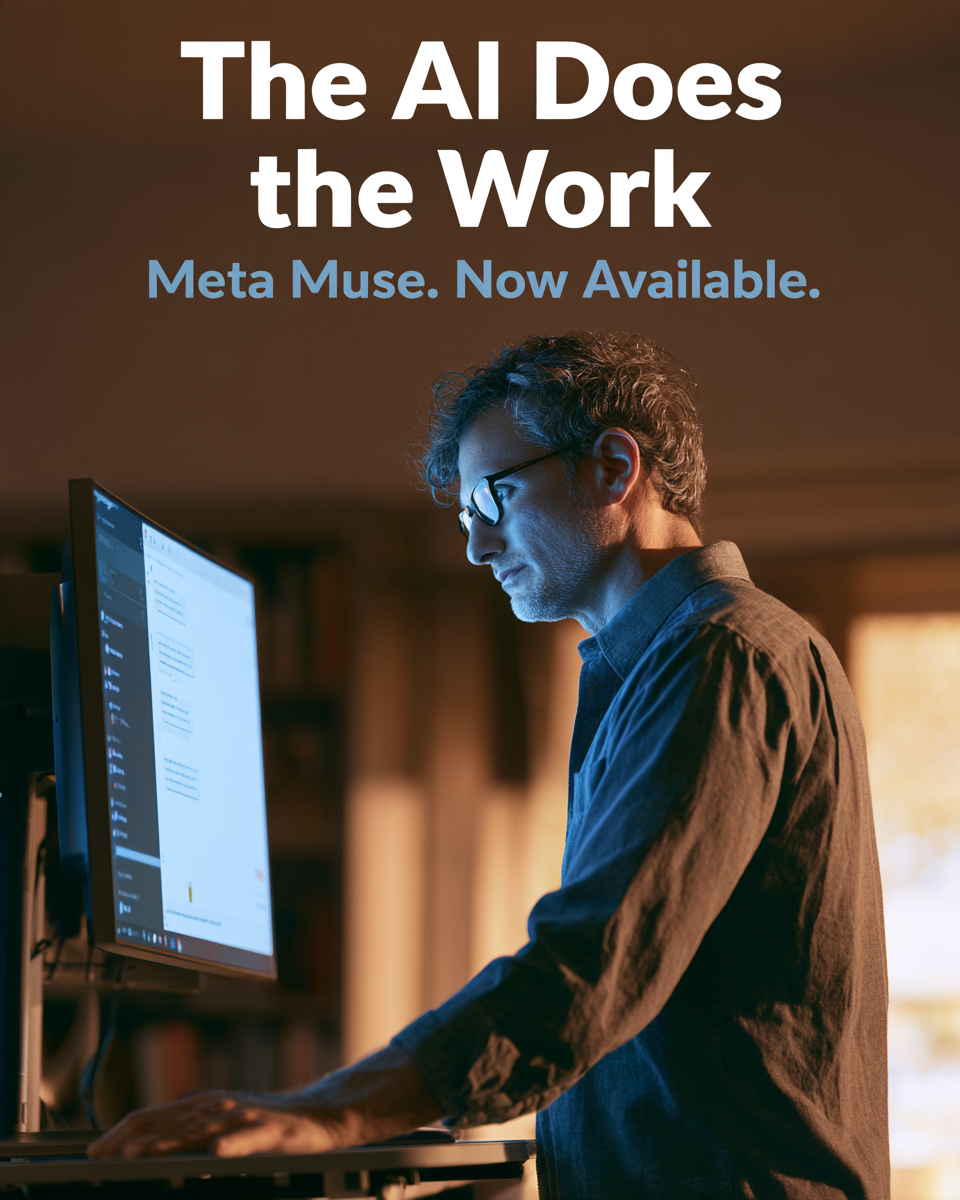
Meta just introduced Muse, and it is not another chatbot. It is an AI that takes action. While most tools wait for your next question, Muse gets to work. Here is what that means for your business. Image created in Midjourney.
Key Takeaways
• Meta Muse is an AI agent, not a chatbot. It takes action rather than giving advice.
• It launched September 8, 2026, in the United States via muse.ai, iOS, and Android. Free, with paid tiers at $20 and $100 per month.
• Muse connects to your email, calendar, payments, and other apps. That connectivity is both the value and the risk.
• Trust is the real question here. Proceed carefully, not quickly.
• The consumer AI agent market is projected to reach $12 billion in 2026 and grow over 40% annually. Muse is the largest mainstream entry point to date.
What Is an AI Agent, and Why Does It Matter?
Before Muse, most of what you have probably seen from AI falls into one category: advisor tools. You ask a question. The AI answers. You decide what to do with the answer.
An AI agent is different. You give it a goal, and it figures out the steps and executes them. It opens a browser, fills in a form, sends the email, books the table. You come back when it is done or when it needs your approval on something.
Most consumer AI products in 2026 still operate as advisors: they draft an email, suggest a plan, or summarize a document, and a human executes the final step. Muse is built to close that gap.
If you have been following the AI space, you may have heard of platforms like Manus that operate in this agentic category. Muse is Meta's consumer-facing entry into the same territory. The difference is scale: Meta is distributing this through billions of existing users on WhatsApp and Instagram, not just to early adopters.
How Does Meta Muse Work?
Muse is a personal AI agent. It does not just answer questions; it actually does the work. It helps people stay on top of things, takes tasks and projects off their plate, and turns long-term goals into action plans.
It exists in a chat interface, similar to a text thread. Users can name their agent, create an avatar, and customize how it communicates. The Muse agent runs on a dedicated virtual machine in Meta's cloud, with a built-in browser visible to the user.
A separate layer called Sentinel monitors and approves every connector action and every network request before Muse acts on it. Tasks it can handle include sending an email, booking travel, filling out a permission slip, negotiating a bill, and planning a project with a multi-step timeline.
What the Numbers Say About Where This Is Headed
•The consumer AI agent market is expected to reach $12 billion in 2026 and expand over 40% annually.
•The AI agents market is estimated to reach $7.63 billion by 2026 and $50.31 billion by 2030.
•Companies using AI agents see a 61% boost in employee efficiency.
•90% of companies using generative AI agents report improved workflows and smoother operations.
•Within days of launching, Muse climbed to the number two position on the U.S. App Store Top Charts.
•More than one million businesses used Meta Business Agents weekly in Q2 2026, before Muse launched.
What Credible Sources Are Saying
Reaction from credible analysts and technology observers has been split between genuine enthusiasm for the architecture and pointed concern about the trust question.
On the technology side:
The design choices are getting credit. The architecture runs inside a dedicated Secure Virtual Machine (VM), uses a separate Sentinel layer for internet control, protects connected credentials, supports approval before sensitive actions, and exposes an audit trail.
On the trust side:
Less than two weeks after Meta agreed to a massive $18 billion multistate settlement in a lawsuit over social media consumer harms, the company announced its biggest bet on consumer AI to date. Meta is now asking adults to hand a new product their inbox, their calendar, and their credit card.
Reuters reported security problems during internal testing, showing that the risks grow as the agent's permissions grow. In April 2026, the FIDO Alliance launched an Agentic Authentication Technical Working Group to address exactly these kinds of concerns.
This is not a reason to ignore Muse. It is a reason to approach it carefully.
The Reframe: Agentic AI Is Not a Feature. It Is a Category Shift.
Most of the small business owners I work with think about AI the way they think about software. You buy a tool. The tool does something. You are still in charge of every decision. Muse is asking you to move something. Not just a task, but a category of judgment.
The business owners who treat Muse like a tool to set up once and forget will have a bad experience. The ones who treat it like a new employee, something that needs clear instructions, limited access at first, and a defined scope of work, will likely get genuine value out of it.
Before you add Muse to your stack, know what problem you are solving and what access you are actually comfortable granting. That decision framework is the same one covered in the AI platform comparison post.
What the Pricing Actually Looks Like
•Free tier: Available at launch. Covers most everyday use cases.
•$20 per month: For heavier personal or small business use.
•$100 per month: For power users with high compute needs.
For a small business owner exploring Muse for the first time, the free tier is the right starting point. Muse is currently available in the United States through muse.ai, on iOS, and on Android. WhatsApp integration is already available.
You should not have to do everything yourself. Meta Muse handles the heavy lifting so you can focus on what only you can do. Less busywork. More results. That is the shift agentic AI makes possible. Image created in Midjourney.
Frequently Asked Questions
Is Meta Muse safe to use for a small business?
The security architecture is more thoughtful than most consumer AI tools. Muse runs on a dedicated secure virtual machine, uses a separate Sentinel layer to approve every connector action, and gives users an audit trail. That said, trust is a legitimate concern given Meta's recent legal history. Start with low-risk tasks before granting broader access.
How is Meta Muse different from ChatGPT or Claude?
ChatGPT and Claude are primarily advisor tools. They generate outputs for you to review and act on. Muse is an agent. It takes action across your connected apps on your behalf. These are different categories of AI, not just competing products in the same category.
What tasks can Meta Muse actually do?
At launch, Muse can send emails, book appointments and travel, fill out forms, negotiate bills, build multi-step project plans, and make purchases through connected payment systems. It connects to services including Gmail, Google Calendar, WhatsApp, Spotify, and Shopify.
What does Meta do with the data Muse collects?
Meta states that Muse conversations and virtual machine data are not shared with its ad systems. An encrypted version, called Muse Confidential VM, is planned for later in 2026. Reviewing Meta's full privacy terms before connecting sensitive accounts is a reasonable precaution.
A Practical First Step
Start with the free tier. Connect one app that does not touch finances or client data. Let Muse handle one specific, repeatable task for two weeks. Read the audit trail after each run. Then decide whether expanding access is worth it based on what you actually experienced.
If you are not sure where AI agents fit inside your broader business strategy, the AI Readiness Check. Ittakes about three minutes and gives you a specific starting point. And if you want this kind of analysis delivered weekly, the AI Edge newsletter is where it lands first. Subscribe.
The Last Thing Worth Saying
Muse is three days old as of this writing. Its track record in real business settings is, by definition, thin. The architecture is serious. The trust question is real. The market it is entering is growing at over 40% annually, and Meta has the distribution to reach people that no other AI company can match.
The gap between owners who understand what agentic AI is and those who do not will widen significantly over the next 12 months. You do not need to be first. You need to be informed.
The agent does the work. You still have to decide what the work is.
Book a free 20-minute AI Discovery Call. Bring your answer to the question. We will find out together whether the application exists.
Michael Carmine, Ed.D., MBA, is the Founder and Chief Executive Officer of AI Educational Solutions (AIES), a boutique AI consulting and training firm based in Chapin, South Carolina, serving small and medium businesses across the Midlands and nationally. He holds a doctorate in Curriculum and Instruction with a specialty in Instructional Design and Technology, and has trained over seven hundred professionals across the United States, South Korea, and Qatar. Most AI consultants come from technology. Michael comes from education, and that difference shapes every tool he builds.
Meet Michael, Founder & CEO of AI Educational Solutions, LLC
Passionate About Making AI Simple and Useful
Michael started AI Educational Solutions, LLC after noticing a major gap: many small businesses and educators were investing in AI training that was too technical, too generic, or failed to deliver real-world results. He believes organizations should never waste time, money, or momentum on solutions that look impressive in theory but fail in practice. When companies invest in AI, they should walk away with operational clarity, improved efficiency, and a competitive advantage. That standard is non-negotiable.
AI Educational Solutions helps by assessing your needs, suggesting the right tools, and providing hands-on training so you leave feeling confident in using AI effectively.